
Public chargers grab the headlines. But once you’ve got an EV charger at home, you’ll barely think about them. Most people just plug in overnight, no fuss, no drama. Get the installation right, check the wiring’s up to scratch, and pick a tariff that suits. After that, charging just happens.
Do you need a dedicated charger?
You can run a lead from most electric cars straight into a normal three-pin socket. We see this a lot. It works, but it’s slow, often far too slow for regular use. Those socket outlets under the stairs or in the garage aren’t built for several hours of heavy charging every night. They start to warm up, sometimes smell odd, and we’ve seen a few that give up altogether. A proper wall charger, fixed to the outside wall or in the garage, does the job faster and with less risk. It’s safer as well. That’s why car manufacturers and most installers always say, get a dedicated charger put in.
How much charge you get overnight comes down to three things: the charger’s capacity, the age and layout of your house wiring, and the car’s own onboard tech. Nearly all home chargers will put enough in for the next day’s driving by the morning. For most, that’s all you need.
Checks before you install an EV charger at home
- Off-street parking close to where the charger will go.
- Your consumer unit and wiring can take the extra load.
- Your mains supply is big enough, which the installer checks.
- A sensible route for the cable from the fuse board to the charger.
- Good mobile or Wi-Fi signal if you want a smart charger.
Older homes sometimes need a consumer unit upgrade first. Better to find out at the survey than halfway through fitting.
Smart chargers and tariffs
Smart chargers let you schedule charging for the cheapest hours, track what you use and sometimes respond to the grid. Paired with an off-peak electricity tariff, they can make running an electric car much cheaper than filling up with fuel.
Many cars can schedule charging themselves too. Either way, the aim is the same: plug in when you get home, and let the car charge during the cheapest hours while you sleep.
Look at the tariff as carefully as the charger. Some are designed specifically for EV owners with long, cheap overnight windows.
Charging from solar panels
If you have solar panels, some chargers can use surplus solar power to charge the car during the day. It works best if the car is at home in daylight hours. A battery adds flexibility, but it's not essential to make solar and an EV work well together.
If the car is usually out at work during the day, a battery can store solar power for the evening charge. Weigh that against a cheap overnight tariff, which may do the same job for less.
The best place to charge an electric car is the one you park in every night.
Where the charger goes
Most chargers mount on an outside wall near the parking space. The cable should reach the car's charging port comfortably without stretching across a path where someone could trip. If the drive is far from the house, a post-mounted charger is an option, but it needs a cable run underground.
Think about looks as well. A charger is on the front of the house for years, so choose a model and cable tidy that sits neatly, and agree the cable route with the installer so there are no ugly runs across the brickwork.
Untethered chargers have a socket and you use your own cable. Tethered ones have the cable attached. Tethered is convenient; untethered looks tidier and suits more cars.
Energy monitoring
An energy monitor shows you exactly what your car, house and solar panels are using, right as it happens. You can see when the tumble dryer’s running, or when the car’s pulling its hardest. Useful for shifting charging to the cheaper hours. Some chargers link up with these monitors too, so you’re less likely to trip the main fuse if you’ve got the oven on and the car plugged in.
Some chargers go a step further. They’ll dial down the charge automatically if the house is drawing a lot, then pick up again when things calm down. Ask about this if you’re worried about overloading the supply. It can save you from needing a bigger fuse out at the meter.
What happens on installation day
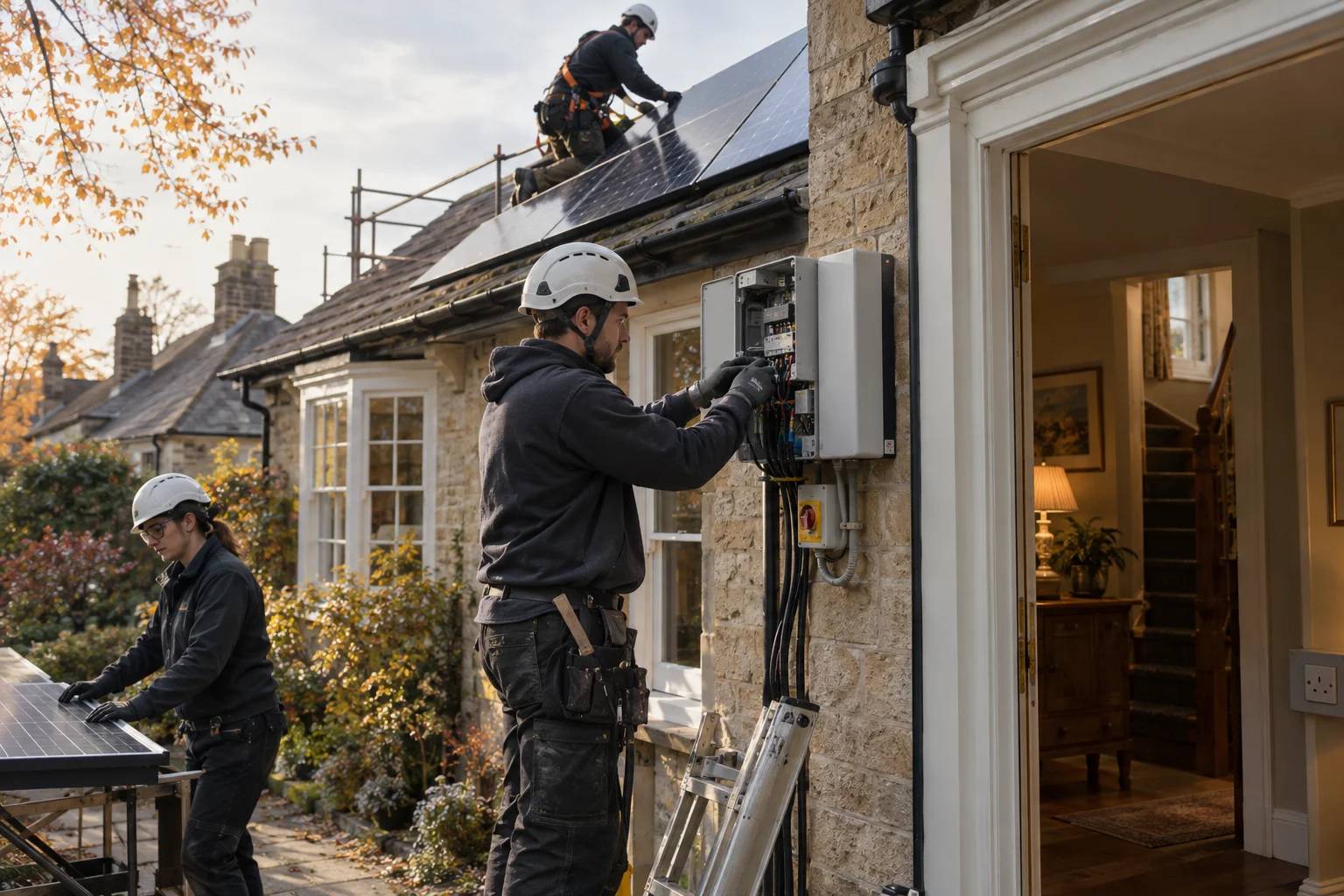
Most installers finish in a morning or an afternoon. Power cuts out while the electrician runs cabling from your consumer unit to the charger, usually outside, near the drive or garage. Any extra safety kit goes in, then they’ll test and switch the supply back on.
You’ll get shown how the charger works and what the app can do. Schedules and tariffs get set up on the spot, if you want. If you’re on a smart tariff, ask them to sync it there and then. And don’t let them leave without the certificate.
Before they tidy away, plug your car in together and check it charges. Takes a minute. Worth doing, saves another visit later.
Our view
We stick with a proper smart charger every time, not a three-pin plug on an extension. Wiring comes first. If the cabling's old or looks a bit suspect, get it sorted before you think about installation. And don’t just stick the box by the front path for convenience, think about where you’ll actually park, now and in a year or two. A decent off-peak electricity rate saves a fair bit, too.
