
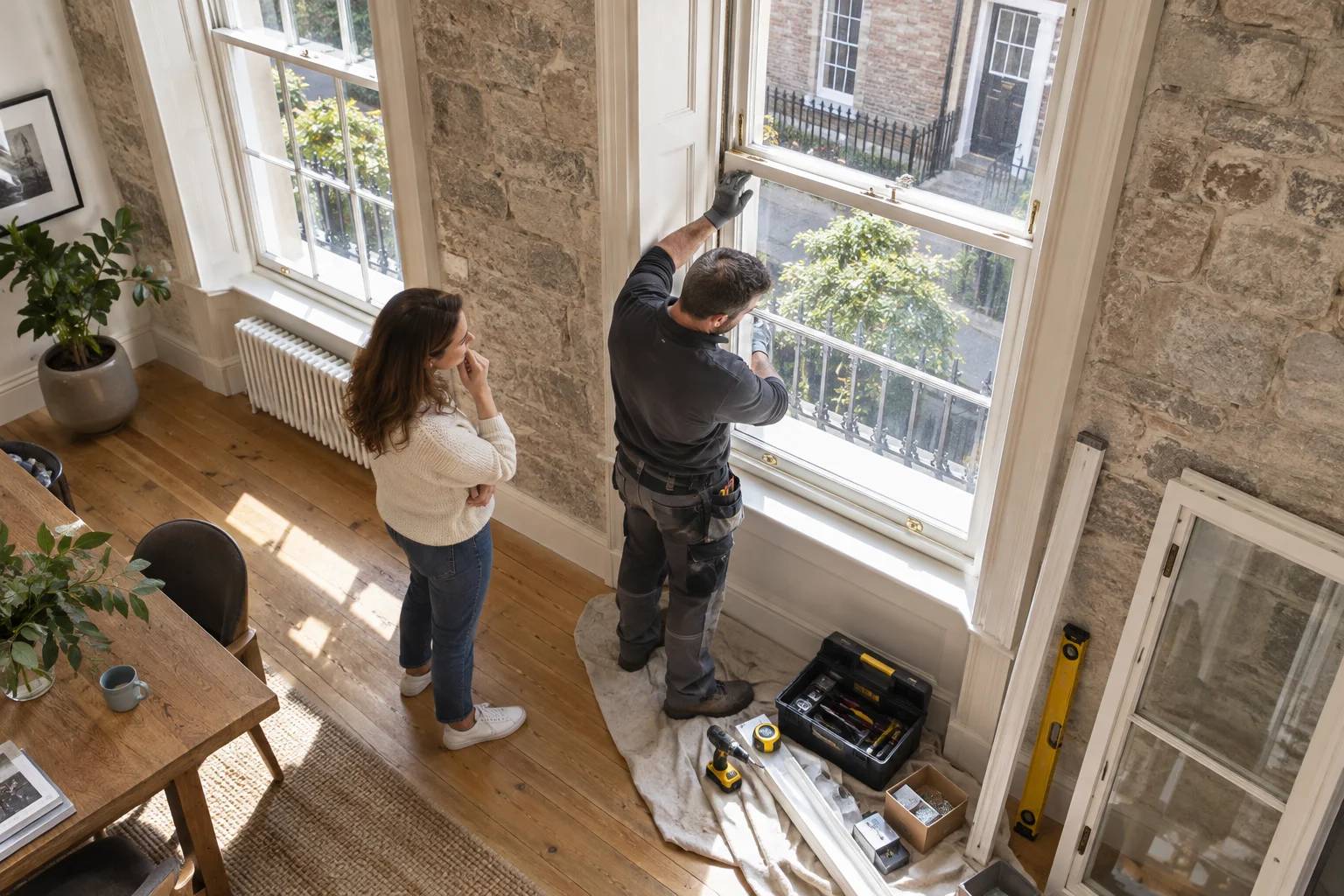
Most people start sizing up windows by peering at the glass. Not us. We'd look at the frame first. It's what you'll see every time you walk past. It sets the lines, whether you get a chunky border or something slim that almost disappears. And it's the bit that takes the brunt of weather, sun and knocks, year after year.
Three materials show up in nearly every street: uPVC, aluminium and timber. None suits everyone. It comes down to your house, your budget, and how you use your rooms.
uPVC vs aluminium windows: what each frame is like
uPVC does what you need. Keeps warmth in, keeps draughts out, just as a plastic frame should. Needs barely any looking after, bit of soapy water with a cloth when it starts to look grubby. If you’re swapping every window in the house, it’s usually the lowest price by quite a way. But the frames themselves are bulky, especially on the cheaper end. Thick sightlines, flat faces. On old brick or stone, they can stick out like a sore thumb. Not always an easy fit.
Aluminium’s the strong one. You get slimmer frames, bigger panes, handy for modern extensions, bifolds or those huge sliding doors everyone wants at the back. The proper ones have a thermal break inside, a strip that stops cold passing through the metal. Without it, aluminium turns icy and condensation pools along the inside edge. Cheap frames without this are the usual problem. We see that all the time.
Timber’s still about, and often suits older houses best. Engineered wood from the factory deals with the old issues, less swelling, less warping, no endless paint scraping. You won’t be repainting every summer. Needs more care, mind. Still, nothing else feels quite right in a period home.
There is another way: composite frames. Timber inside for warmth, aluminium outside to take the weather. Gives a room the right feel and shrugs off the rain. Nearly always the highest price. Sometimes, though, there’s no better choice.
Insulation, noise and comfort
The glass does most of the heavy lifting for warmth and noise, so you need a fair comparison. Make sure you're looking at the same double or triple glazing in each frame when weighing up uPVC vs aluminium windows. But it's not just about the glass. The whole-window energy rating counts far more than the spec sheet for the glass alone. A cold frame or sloppy seal will waste every penny you spend on decent glazing. Get this wrong and you’ll pay more to keep the place warm, yet still find chilly patches or condensation round the frame on a damp morning.
It’s much the same with noise. Laminated or acoustic glass does its job, but only if the frame and its seals are up to standard. A perfect frame, fitted poorly, will still whistle in a gale or let the traffic in. Draughts are almost always about the fit, not the product. So who’s installing your windows matters every bit as much as which ones you pick.
When you’re comparing companies, ask for the whole-window energy rating and the frame depth, and get it in writing. You’ll often see two quotes, both boasting ‘A-rated double glazing’, but one might use a thinner, less insulating frame. That means more heat lost, and less noise blocked. Cut corners here and you’ll end up with higher bills, or calling someone back to fix the job.
Looks, light and the style of the house
Window frames shape a house, more than most realise. They draw the eye, inside and out. Get it wrong and it jars, particularly on older homes. We see it often enough: stark white uPVC stuck on a Victorian terrace, never quite sitting right. People notice straight away. Changing frames isn’t quick or cheap. If you need to redo the lot, you’re into the thousands. Best not to rush it.
Aluminium works well for new builds and modern extensions. The frames are slim, so you get more daylight and a bigger feel to the room. Suits big panes, sliding doors, anything that runs floor to ceiling. On older places, though, it can look sharp and out of place. Softer edges or muted colours can help. If you’ve got stone or aged brick, too much shine will stick out. A quiet finish goes a long way.
uPVC isn’t what it used to be. Now there are woodgrain effects, flush sashes, finishes that can pass for timber if you pick carefully. Always hold a real sample against your brickwork or stone. Never rely on a brochure or what you see on a screen. Colours and grain shift in proper daylight. If you can, look at a local house with the same frames. It’s the only way to be sure.
If your house is listed or sits in a conservation area, check with the council before you do anything. Some insist on timber and won’t give way. Get it wrong, you could be made to rip the frames out. We’ve seen uPVC go into a 1930s semi in a conservation zone, council stepped in, owner ended up paying twice to put it right.
How long each frame lasts, and the upkeep
A good window frame should just get on with it, year in, year out. No fuss. Aluminium’s the one that rarely lets you down. We still see windows from the eighties, powder coating intact, frames straight, nothing wonky, unless someone’s gone at them with a scouring pad. Wipe them now and then, a touch of oil on the hinges, and you’re done. Aluminium’s as close as you’ll come to fitting once and forgetting.
uPVC holds up pretty well too, in most spots. Expect two decades, maybe three, before the frame starts to show its age. Sunlight’s the culprit on south-facing walls. That’s when the white goes a dull yellow, or the plastic gets brittle and cracks after too many hot summers. Loose handles, seals that shrink back, draughts sneaking in, we hear the same complaints time and again.
Timber’s a different story. If you keep up with the painting, it can outlast both plastic and metal. But miss a year, or let water get at the cill or the bottom of the sash, and rot gets in, quietly, usually out of sight. Fixing it means a joiner and a bigger bill. Old timber frames aren’t forgiving if you let things slide.
Don’t just take a warranty at face value. The headline number might look the same, but dig into the details. One firm might cover the frame for ten years, but only back the hardware or handles for two. Small print varies, and not every firm spells out what’s excluded. Always ask.
Take a three-bed semi with new uPVC. If a seal starts peeling or a handle gets stiff, leave it and you’ll soon feel a draught by the skirting or spot a damp mark under the sill. Put it off and that quick job will grow, and so will the bill. Sort little faults straight away, and most bigger problems won’t turn up.
What to ask before you sign a quote
Never sign until you’re clear on every last detail. What are you actually getting for the money? Not all window systems are made equal. Some names last, some don’t. Pin them down: which make and model is in the quote, and who’s making it? If they give you the run-around or can’t answer straight, walk away. Too many houses end up with flimsy, no-name frames that rattle, let the draughts in or just give up altogether after a few years. That bargain price won’t feel so clever when you’re shelling out for repairs, or worse, replacing the lot.
Paperwork matters here. Say you want the job registered with FENSA or Certass if it needs it. Miss out on the certificate and you’re in a hole, especially if you come to sell or remortgage. Lenders get nervous if the windows aren’t signed off. If a company won’t certify, you’ll be left chasing building control and picking up the bill. Nobody needs that.
Glass specs aren’t all the same, either. Two quotes might look similar but hide a world of difference: one could be single glazing, the other triple. Some will throw in low-e coatings, argon gas, maybe an acoustic layer. These all change how warm or quiet your room feels. Go through every item. And ask exactly how they’ll seal the frames to the wall. Get that wrong and you’ll know the first time it rains or the heating’s on.
The guarantee’s important, too. Not just the headline number of years, but what’s actually covered if things go wrong. Get it in writing. Check what happens if the company folds. We always look for an insurance-backed guarantee, there are too many empty promises out there.
Fitting day and the finish around the frame
Fitting day matters more than most think. The best frames can be ruined by a rushed job, and you’ll spot the signs before the dust has even settled. We've seen teams rip out old windows fast, chunks of plaster coming away, sills knocked about, even bricks chipped or split outside. Good fitters slow down at the start, check that the opening is square, the base solid, and nothing’s in the way. If they skip that, you’ll get draughts, leaks or windows that stick as soon as winter cuts in.
Every new frame needs careful packing and fixing. The seal matters, inside and out. If they leave gaps, you’ll feel cold edges or find rain trickling in behind the trim. It’s not a cheap fix, either. Most firms won’t come back in a hurry if the job’s poor, no matter what they promised before you signed.
Ask how long they’ll spend fitting each window. Anyone claiming your whole house will be done before lunch isn’t taking care. One or two hours per window is fair, more if it’s a bay or something awkward, like over a conservatory. Pin them down on the finish: who’s doing the plaster? Are you getting new cills, trims, or just the bare frame? Finish work is where some quotes climb, but you get what you pay for.
Low prices can come back to bite, when you’re left patching cracks or chasing up missing bits. Better teams leave a clean edge, ready for paint, nothing for you to put right. Get a written breakdown, line by line. Keep everything, registration, guarantee, product details. You’ll need them if you ever sell or something goes wrong down the line.
Our view
The wrong frame stands out straight away. Maybe there’s a chill by the sofa, mist between the panes, or the profiles just jar with the rest of the house. uPVC keeps bills down and does the job for most homes. Warm enough, decent noise cut, and it blends in on an ordinary street. But give the sill a tap and it’s not exactly solid. Aluminium costs more, that’s just how it is. If you want big openings, clean lines or a sharp look, it’s the obvious pick. Timber’s best where you need to match what’s there or planning says so. Looks lovely, but you’ll be reaching for the sandpaper more often than you’d like.
Getting the fit right matters more than anything. Too many times we’ve seen someone rush it, then you’re left with leaks, stiff handles or a guarantee that means very little. Always ask how they seal the outside edge. Get clear on exactly what their guarantee covers, don’t let them dodge the detail. Ask to see other jobs they’ve done. For aluminium, check they know about thermal breaks and proper insulation. Miss that and you’ll spot draughts, damp patches, maybe water creeping in where it shouldn’t.
Take a typical three-bed, ten windows to swap out. uPVC is far cheaper than aluminium. But too cheap rarely lasts. Go down that road and you’ll be sorting out gaps, fiddling with seals, or ringing for repairs sooner than you’d like. Take your time. Pick the right frame, and a fitter who knows what they’re doing. Cut costs now, and you’ll pay for it later. We see it all the time.
